A practical guide for clinicians: Proper use of a Foot Abduction Brace/Boots & Bar (FAB/BnB)
Real-World FAB/BnB Shoe Application Techniques
To Prevent Slipping, Blisters, Pressure Sores, and Bracing Intolerance
This guide is not meant to replace Ponseti training. It is meant to convey to providers the real-world details, techniques, and practical tools parents need when the brace is being applied to a wiggly baby at home.
It is common that providers are not aware of the techniques and fit principles of comfortable and correctly fitting shoes and bar. It is even more common that parents are given little or no education/instruction or guidance even when the provider is aware of these things. This guide aims to change this so that every clubfoot child is comfortable and safe from harm while bracing, and parents are given the proper tools and techniques to use the brace effectively from the moment they and their child begin bracing.
Beginning Bracing with Freshly Corrected Feet.
Best Day Yet!
Off comes the final cast and parents move on to the bracing phase of the Ponseti Method!
This can be the hard part, but it does not need to be.
Parents are often told how many hours to brace but receive only limited practical guidance on how to apply the brace correctly. They may not be shown how firmly the heel must be seated, how tight the shoe often needs to be, how to check for movement, or why being too gentle can lead to slipping and blistering. Without that instruction, parents may not know what a properly fitted shoe should look or feel like.
One of the biggest differences between a secure shoe and one that causes blisters or sores is parent understanding of proper fit. When parents are given little instruction—or incorrect instruction—they may not recognize when the heel is not fully seated or when the shoe is not secure enough.
In addition to limited instruction, many parents are afraid of hurting the baby. They may worry about tightening the shoe too much or cutting off circulation, and that fear can keep them from using enough pressure when applying the shoe. If they are not shown how to position the foot correctly and secure the shoe firmly, they may believe it cannot be tightened any further when, in fact, that is because it has not yet been applied properly.
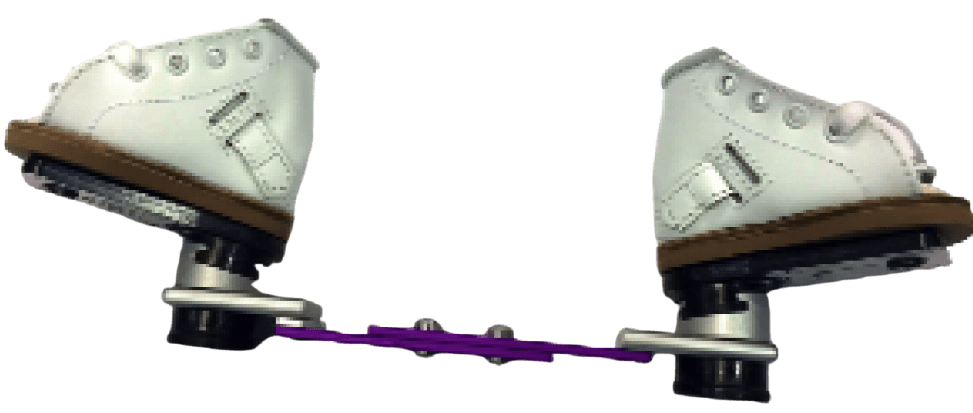
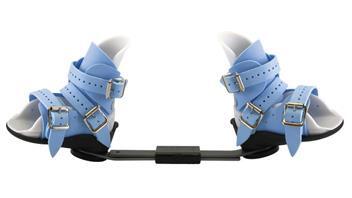
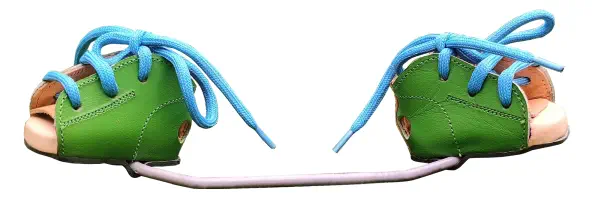
These principles apply to all Foot Abduction Brace/Boots and Bar (FAB/BnB) shoes, regardless of design. The shoe must be fitted securely enough to keep the heel fully seated without movement. If the heel rises or shifts during leg motion, the fit is inadequate. Changing shoe models usually does not correct the problem.
It is not the shoe style, design, or brand that's causing the problems, it’s the fit.
Parents commonly experience a cascade of failures once the problems begin. They may try to solve the issues with “things” they add to the shoe such as moleskin or padding, and orthotists are notorious for adding “things” to shoes or removing parts of them in efforts to solve the problems. The success of these measures is limited at best, and as a result many parents end up chasing fixes that do not solve the real problem.
The following pages explain the how and why behind common bracing problems, including intolerance, slipping, and sores. These problems are often preventable when parents are taught correctly from the start. Providers must teach the necessary techniques, reinforce the key bracing principles, and make sure parents are truly prepared to apply the brace correctly at home.
Sores - Blisters vs. Pressure Sores: Why the Difference Matters.
Sores that develop during bracing are serious injuries. Once the skin begins to break down, these wounds often heal very slowly while bracing continues and, in many cases, will progressively worsen. They can become severe, painful, and distressing for both the baby and the parents.
These sores most commonly occur on the heel and under the middle strap of a three-strap shoe. Once the skin is damaged, the wound must be properly protected and the underlying cause of the sore must be corrected. In most cases, this means correcting the fit and mechanics of the shoe rather than simply adding padding or modifying the brace.
It is critical to understand that not all sores are the same. The most common sore on the heel of a clubfoot is a friction blister caused by movement of the heel inside the shoe. In contrast, sores on the heel of the non-clubfoot and sores beneath the middle strap are usually pressure sores caused by excessive pressure against the skin and underlying tissue.
Because these sores occur for different mechanical reasons, they require very different solutions. A friction blister is solved by eliminating movement through proper heel seating, proper strap positioning, and a secure fit. A pressure sore is solved by reducing pressure at the affected area while still maintaining proper overall fit and support.
>These problems are generally not solved by adding soft materials, extra padding, cushions, or random shoe modifications alone. Unless the underlying fit mechanics are corrected, the sores usually continue to worsen.
Blisters (most common type of sore)
 Sores on the heel are almost always friction blisters. A blister forms when
the heel moves against the inside of the shoe and creates friction and heat.
It is the same basic thing that causes blisters in new shoes or on hands
during repeated work. When parents understand it in that real-world way,
they can more easily understand why secure heel seating and a very tight
shoe matter so much in preventing blisters.
Sores on the heel are almost always friction blisters. A blister forms when
the heel moves against the inside of the shoe and creates friction and heat.
It is the same basic thing that causes blisters in new shoes or on hands
during repeated work. When parents understand it in that real-world way,
they can more easily understand why secure heel seating and a very tight
shoe matter so much in preventing blisters.
Blisters are usually red on the outside and white in the center at
first. That pattern strongly suggests friction and movement rather than
pressure. They can be large, as shown in the first image, or very small
and subtle, as seen to the right.
Even a very early blister can become more of an issue or take time to
resolve even if the underlying movement is corrected.
Once the skin breaks, the blister becomes an open wound. Catching these
blisters early and changing the way the foot is secured in the shoe is
critical. If you know it is a blister, then you know the heel has been
moving and the shoe has not been tightened secure enough. If caught early,
it may heal simply by correcting the fit and eliminating the movement. It
does not take much movement or much time in a loose shoe for a blister to
form and then worsen.
Don’t Blame the Baby:
Slipping is caused by fit, heel position, and tightness. It is not caused by
the baby being especially strong, stubborn, active, or “good at kicking them
off.” No child “learns to kick their brace off”. Baby legs are strong, but
that is exactly why the shoe has to be put on correctly. Once the bar is
attached, it acts as a lever and can increase the force applied to the foot
by many times.
Every application must end with a movement check—the push-and-pull-and-twist
test
by grasping the shoe at the heel of the shoe and the test
must be performed with real effort. A gentle tug is not enough force to
check for movement. If there is movement, the shoe needs to be redone.
Parents need to understand this clearly: if the heel moves inside the shoe,
the shoe is not tight enough yet. As soon as they notice movement, remove
and then re-don the shoe.
Tell parents very specifically:
Do not leave the foot inside a slipping shoe. If
the heel moves, it must be redone.
 This is not a race.
If the baby is upset or the parent is overwhelmed, it is recommended to
stop, regroup, have some milk and cuddles, settle and relax, and then try
again. It may take many attempts to get it right, and parents need to know
that this is okay. It does get easier with time and practice.
If the heel can rise inside the shoe, then it can also move up and down.
That movement is what causes friction blisters on the heel. Sometimes the
heel also rises and presses against the inside of the shoe, which can cause
a pressure sore instead of a blister. In rare cases, a foot that stays
slipped up could even place the foot at risk in a way similar to a slipped
cast, particularly in complex clubfoot.
Non-Clubfoot Pressure Sores (heels)
The three-strap infant shoes have a silicone liner with a deep heel pocket
and heel counter. For the clubfoot, this is helpful because it keeps the
heel seated and encourages the heel to drop.
In many unilateral cases, the unaffected foot does well in this design. In
some children, however, the unaffected heel has a more prominent bony
contour, and the heel counter creates a deep purple pressure sore.
This is not a friction blister caused by movement. It is a pressure injury.
That distinction matters, because the solution is not a tighter shoe or
simply eliminating movement. As long as the heel counter continues to press
into the heel, these sores are extremely difficult—and often impossible—to
heal.
Even after a break from bracing, the sore often returns as soon as the shoe
is put back on unless the pressure itself has been eliminated.
Doctors need to recognize these sores early and stop treating them like
ordinary heel blisters. On the unaffected foot, a heel sore is rarely caused
by movement unless the shoe is very loose.
The early appearance is distinctive: deep purple discoloration, sometimes
with an indentation.
Early recognition is critical. Once this type of sore appears, it almost
always worsens unless the pressure is relieved. Some appear overnight and
are already severe when first noticed. Others evolve over several days, but
they still become severe if the underlying pressure continues.
By the time the deep purple discoloration is obvious, deeper tissue has
often already been injured. The skin may then slough, leaving an open wound.
Several solutions have been tried with limited success. These include
pushing the foot forward with foam or corn pads, grinding down the heel
counter inside the liner, or making a slit in the heel of the silicone
liner.
In parent experience, the most consistently effective solution has been to
cut a hole in the back of the shoe exactly where the heel counter or top of
the deep heel pocket is pressing into the heel.
Parents can do this themselves with a sharp razor, such as an X-Acto knife
or small box cutter. In many cases, this is more effective than repeated
orthotics visits or hoping that grinding alone will be enough.
To find where to cut, place an adhesive dressing such as a Band-Aid or
plaster over the sore and apply lipstick or petroleum jelly to the outside
of the dressing to mark the center of the pressure point. Then press the
foot into the shoe as usual and transfer that mark to the inside of the
silicone liner.
That is where the cut should begin. Start with a small hole and enlarge it
only as much as needed.
The shoe will generally continue to work well with this modification. Even
if the heel portion of the silicone liner eventually weakens, the shoe still
functions because it is the outer shoe material—not the liner alone—that
secures the foot.
Most infants also outgrow each shoe size fairly quickly, so long-term liner
durability is usually less important than preventing an ongoing pressure
injury.
These images show several modifications that parents have tried. None appear
to damage the function of the shoe. You may wish to explore which approach
works best in your practice, but the cut-out hole has been reported by
parents to work quickly and reliably, and in our experience it is often the
most effective solution.


Pressure sores are deep/dark purple.
This must not be ignored, and the pressure must be eliminated immediately.


This is the same baby, the parents covered it with a “Band-Aid” type
dressing. This only added more pressure.
Under Strap Pressure Sores
Conversely, a three-strap shoe may sometimes be tight enough to stop heel
movement and prevent a heel blister, but still cause too much pressure under
the middle strap. In that situation, the heel blister may be avoided, but a
pressure sore can develop under the strap instead. It can feel like a
catch-22. Pressure saddles are not usually very helpful and can sometimes
make the heel problem worse by preventing the shoe from becoming tight
enough and making it harder for the foot to dorsiflex and the heel to seat
properly. Strap-related pressure sores are less common in single-strap or
lace-up shoes, but they can still happen.
Pressure saddles have been around since the Mitchell shoe first came out
available to parents in 2004 because it was clear early on that this kind of
sore was a problem. They have never worked very well, if at all to solve an
active sore. In an attempt to sort this issue after years of failing to
really have a solution for parents, I began asking parents to make some
changes to the position of the straps and stop leaving the top and lower
straps looser. This was approximately 2 years ago, and after 1 year I knew
it worked. The incidence of these sores is nearly nothing in the groups now,
whereas we used to see 3-5 of these sores a week. Now it’s mostly redness
that needs to be reduced, and this is a testament to the success of this
technique.